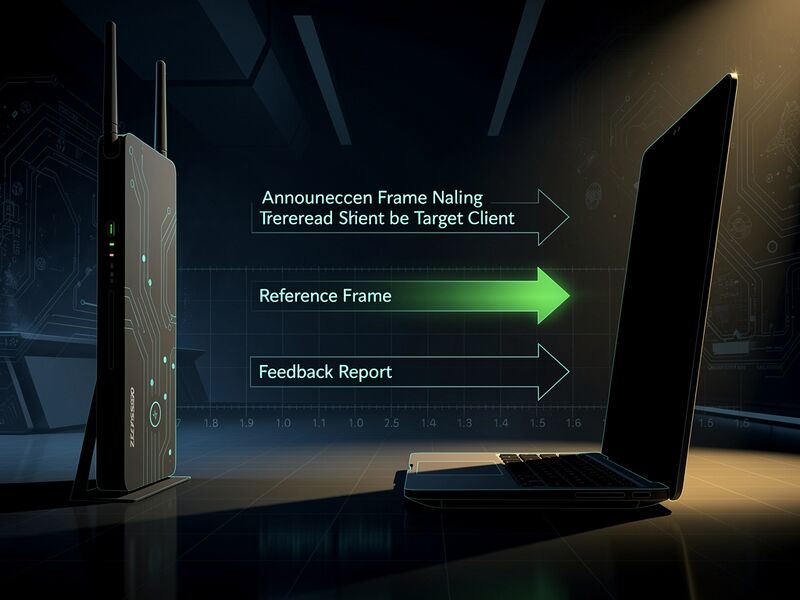
File:Channel-Sounding-The-IEEE-802-11-sounding-loop-NDPA-annou-9b5b3d37.jpg
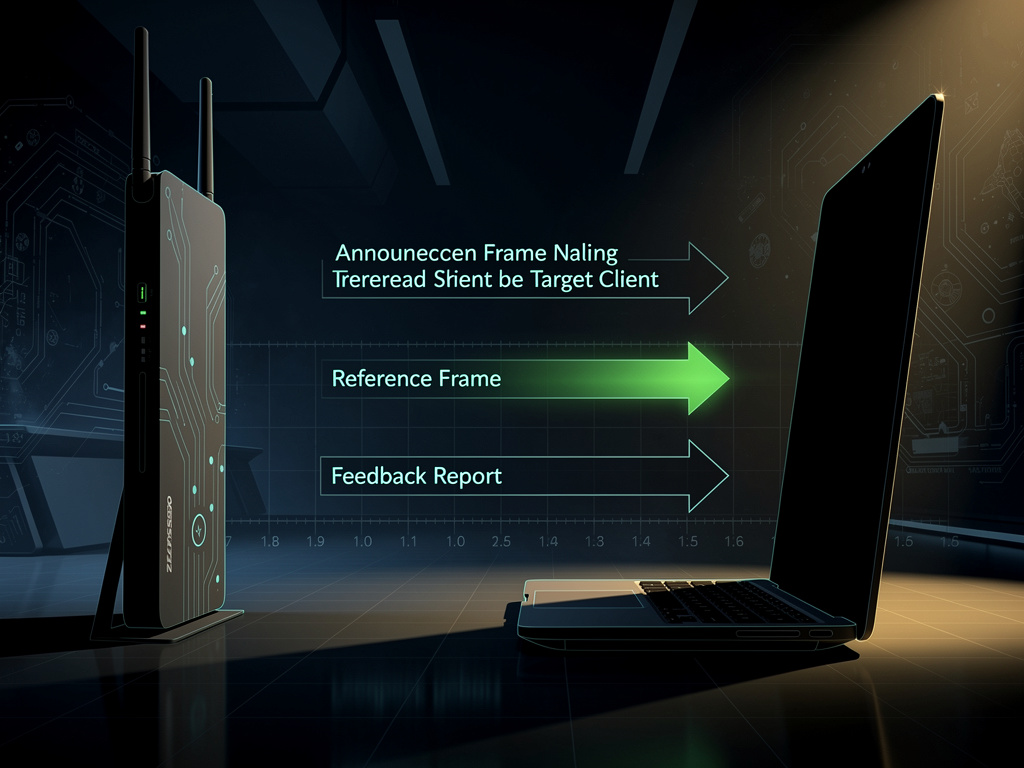
Original file (1,024 × 768 pixels, file size: 218 KB, MIME type: image/jpeg)
The IEEE 802.11 sounding loop: NDPA announcement, NDP reference transmission, and BFI feedback report.
AI-generated illustration for Channel Sounding, made with fal.ai (fal-ai/flux-2-pro).
Prompt: A sequence diagram showing the exchange between a wireless access point and a client device: the access point first transmits an announcement frame naming the target client, then immediately transmits a second reference frame, and finally the client responds by transmitting a feedback report back to the access point. The three-step handshake is shown as horizontal arrows between two distinct devices, with small timing gaps between each transmission. Style: Detailed digital illustration blending technical schematic linework with painterly atmospheric rendering, as if a scientific textbook were reimagined by a noir graphic novelist. Colour palette of deep midnight blue, charcoal black, and slate grey as foundations, accented with electric teal, bioluminescent green, and cold amber. Lighting is dramatic and directional, suggesting surveillance or laboratory environments — pools of cold light against deep shadow, with occasional glowing circuit-trace highlights. Compositions favour tight framing with layered depth: foreground technical detail dissolving into abstracted background geometry. Detail level is high but purposeful, prioritising legible structure over decorative complexity. Mood is clinical yet ominous, precise yet unsettling. No text, lettering, captions, logos, watermarks or borders unless it is a technical drawing.
File history
Click on a date/time to view the file as it appeared at that time.
| Date/Time | Thumbnail | Dimensions | User | Comment | |
|---|---|---|---|---|---|
| current | 09:35, 24 September 2026 | | 1,024 × 768 (218 KB) | Geckopico (talk | contribs) | AI-generated illustration for Channel Sounding |
You cannot overwrite this file.
File usage
The following page uses this file: